31 May, 2014

The Taiwan MRT Stabbing


So a week ago Taiwan was shocked by an incident that took place on the MRT. A young man (a boy really) aged 20 or 21 boarded the last car of a train. Once the train had left the station he produced two knives and began walking down the cars, stabbing people. There were four casualties. When the train arrived at the next station he alighted and continued to wander around the station, menacing people. "Wander" is the right word here. He wasn't running, nor was he trying to find ways to escape. He knew he would eventually be caught and was fully conscious of what he was doing.


For Taiwan this truly was a shocking event. Nothing on this scale has happened in a very long time. To a places like Britain, South Africa, Libya, North Korea, the USA (and every country the USA has invaded) four deaths may seem inconsequential, paltry even. No one there would bat an eyelid.
In Taiwan, however, there's very little violence. The crime that exists is mostly white-collar crime in the region of fraud or embezzlements. Violence tends to take the form of passive-aggressiveness.


This youth was eventually disarmed by an old man with an umbrella and a few security guards. While being arrested and hauled away he kept asking the guards if he'd get the death penalty.


This youth clearly wanted to shock people and he'd wanted to do so for a while now. Subsequent investigations into his life showed that he'd been saying he'd like to kill people for a few years. He'd also wanted to do "something big".

What annoyed me most about this incident was the media. They jumped on the bandwagon with all the wrong notions. The main media story - which can be found on Youtube, along with some footage from the event - that was played over and over kept mentioning that he was a fan of violent video games.
So what?
Many people play games - violent or otherwise - and it has no affect on them. More people get violent about sports teams, but you don't see them being called into question; probably because they make people too much money. Games are an easy scapegoat, as are music, clothing trends and just about any other fringe interest.

More importantly, the main problem is that people are trying to find causes for his actions without looking at the obvious. Every time an event like this happens anywhere in the world, the media descends to make a huge deal out of it. That's what the assailants want - they wish to be known, to be famous even if only through infamy. They want to be remembered and the only way to do that is to make a huge scene. If it's been done before, then they have to try even harder to be better than the scene before. It's disgusting and it gets boosted to media coverage.

It was after that that I found this article. Strictly speaking this article is about killings in school, but the motivations and causes behind them are the same. The whole article is worth reading, but here's a brief summary of the main point:


When a person goes on a murdering spree, this is what happens.

"Gun control gets the headlines. Mental health care gets the headlines. Violence and video games and misogyny and internet forums and atheism — the list is endless at this point.
Here’s what doesn’t get the headlines: Empathy. Listening to those around you. Even if you don’t like them very much.
Despite being relevant and important discussions, the glamorous headlines are ultimately distractions — they just feed into the carnage and the attention and the fame the killer desired. They are distractions from what is right in front of you and me and the victims of tomorrow’s shooting: people who need help. And while we’re all fighting over whose pet cause is more right and more true and more noble, there’s likely another young man out there, maybe suicidally depressed, maybe paranoid and delusional, maybe a psychopath, and he’s researching guns and bombs and mapping out schools and recording videos and thinking every day about the anger and hate he feels for this world."


A link to the full article


10 May, 2014

A Chinese Orchestra

A few weeks back I had the pleasure of attending a concert featuring Chinese instruments. There were two parts to the concert separated by an interval.

Part 1

A middle-aged man, who I took to be the head musician and probably the teacher, came on stage and prefaced each song with what appeared to be rather witty dialogue. I cannot confirm that, as my Chinese is still underdeveloped, but the audience (unlike the queen) seemed amused. 
I believe he had a pipa (琵琶) with him, though it may have been a  liuqin (柳琴).

A pipa


 A liuqin

The music was charming and had a quality to it that's hard to pin down. I'm sure my friend with his musical degree could provide the technical words I lack. Needless to say it was a treat.
After a few songs (and jokes) he left, only to return accompanied by a string of thirteen lovely young ladies, each sporting their own Liuqin. They were all dressed in a mock qipao (旗袍) or cheongsam style. Traditionally the qipao is a one-piece dress with cap sleeves and ending in a cut not dissimilar to a pencil skirt. If I recall correctly, only two of the ladies actually wore a proper qipao. Two others wore evening dresses and the rest had a kind of qipao blouse worn with a separate skirt.


Sitting in a single, long, curved line they played flawlessly together. They played in perfect harmony even when altering the tempo of the music and they played with incredible speed, their hands seeming to dance across the strings becoming blurs.

After a quick rearranging by the backstage team (and I must commend the backstage team on their speed and efficiency) the head musician returned with an entourage of older musicians. They assembled themselves around a table with various instruments laid out. They had liuqins, pipas, sanxians (三弦) and huqins (胡琴). This stage of the concert also saw the introduction of a few woodwind instruments. There was the sheng (笙) as well as the dizi (笛子) which is a kind of bamboo flute.

  A dizi

A huqin

A sanxian

A sheng

During this time one thing became quite noticeable which put a dampener on the event, but not enough to make me stop enjoying it. Chinese instruments were designed and created to be played individually or in small groups, usually to a small reception. Putting this number of instruments together, whilst trying to amplify their sound to the whole chamber, means that some instruments were almost inaudible.
The Sheng I don't believe I heard above the sound of the strings.


Part 2

We returned after the interval to a complete rearrangement  of the stage. A mini orchestra assembled on stage. The orchestra is a relatively new concept to Chinese history. As such, not all of their instruments are designed to work well in groups. Certain instruments have been borrowed from the western orchestra, like cellos and double-basses.

There was even more excitement when a host of operatic singers lined the back wall, ladies dressed in deep, rich pink and men in tuxedos. This is when it became undeniably clear that we were listening to contemporary music rather than traditional.


The singers didn't sing a song. Rather, they had associated pitch to various words and as they sang these words (or perhaps sounds is a better way of describing them) they would alter their pitch. At first it they were simply changing to pitch to the sound "la".
Later they changed to short sentences in Chinese, each word holding its own pitch.

The strangest part of this was the karaoke section. I don't know what else to call it. No other word seems to fit. Whilst in the middle of a tune two of the elder musicians stood up with mics and began singing a duet. Later in the same song the were replaced by two others. The audience seemed impressed by one of them, as though he was singing tongue-twisters or something in a similar vein. It was interesting, but most confusing. I'm still unsure what I witnessed.


Then, because you can never have enough, the thirteen young ladies from before were brought out and added to the orchestra for the finalé. Though odd, it was a wonderful evening out.

12 March, 2014

SRI LANKA - Day Six, Seven & Eight

As day five drew to a close I enquired with our hosts at Point View Villa if they could arrange a tuk-tuk for us for the morning. We informed them that we would like to leave at 6 AM in order to catch the train. They did their usual head wiggle accompanied by the seemingly manditory "okay, okay".
At three minutes past six the following morning I was banging on their doors and windows to wake them up. One man stumbled into view to ask me what the matter was. I told him of my urgency and  he said he'd get the tuk-tuk ready. Instead he meandered through the house, turning on lights and trying not to look like a lost fart in a perfume factory.

My girlfriend gave up waiting for them and headed to the roadside, hoping to catch a tuk-tuk heading for the village. None came. It took our hosts twenty-five minutes to have someone ready to take us to town. Once there we rushed to the lovely old granny to collect our breakfast. She was looking a little worried, which is understandable considering how late we were. A sprint up the road brought us into the train station barely one minute before the train arrived.


The train is slow. There's no escaping that. It also has some spectaculare views and it's well worth taking once - but only once, unless you really like trains and have the time to spare.

Travelling early, we passed many pupils on their way to school. It was wonderful seeing so many children - who clearly had very little - wanting to learn. There was a brightness to life in their eyes, which mimicked the sense of general friendliness exhibited by the people we encountered.


Sadly my battery was running low, so I saved my camera for most of the trip, just taking a few select pictures. Of course I couldn't pass up the opportunity for faulty English.


The downside of taking the train early in the morning is that at times much of the view will be convered in mist - but only for the first hour or two, and only in parts.
The other problem is children. They will get on and they have this annoying tendency to squeal every time the train goes into a tunnel. There were many tunnels. It would appear children are irritating in all cultures.


I got a little panicked when, after arriving in Kandy, our train reversed and began heading back the way it had come. I quickly tracked down a conductor and was informed that the train did backtrack a few stations in order to change tracks. Panic over I relaxed and enjoyed the rest of the trip to Nawalapitiya.


A short (and overpriced) tuk-tuk ride took us to Pinnawala Elephant Orphanage. By the entrance was a foreign exchange, which made me happy, as I was in need of exchaning some money.
We entered the place and after a bit of fuss bought some tickets. We saw a sign about lockers and were hoping we could put our bags down. The guards said we could leave our bags with them. I was sceptical, but they were heavy... so I took a clandestine picture of the guard, just in case anything went missing.

Then we headed down to the river to catch the elephants having their daily bath.


Bathtime over, the elephants were marched back up to Pinnawala. One paused to rub himself against a tree.


Now came feeding time. It was wonderful to see them eating, and even more heartwarming to see the babies being bottle-fed milk later. Unfortunately it was terribly saddening to see the chains securing the elephants.
I understand there's a necessity. They want to keep people safe whilst giving them the opportunity to get close to the elephants. Even so, I think it's cruel. Babies ended up being just out of reach of their parents and restricted in the food they could reach.
A better solution would be to isolate the people and give the elephants free reign.


It would appear free reign did exist for the elephants. This is a fragment of their "open area". Naturally they are kept contained during feeding time, as it's a tourist attraction, but this is their land to live in when not being bothered by tourists.


We left Pinnawala late that evening and caught a bus into town. What was delightful about the bus were the singers in the back. They sang for hours, their songs ebbing and flowing as one whittled down and the next took off. They substituted everything for percusion instruments. Plastic bottles were tapped against window panels, perfectly mimicking the snare drum of a marching band. Hands were slapped on laps or the backs of seats. We were unsure how long it had been going on for, but it lasted for about two hours into our ride.
The bus was packed. We barely had space to fit standing up in the front and it took about an hour before we were seated. It took many hours before we got to Colombo. It's the single most unusual ride I've been on.


Sadly this is where my pictures end. Our last few days were spent running around Colombo buying things and spending the last of our money. Here are some tips which summarise the highlights.

1. Don't trust Hotel Sunshine (5a Shrubbery Gardens Road, Colombo, Sri Lanka) to keep your booking. They cancelled ours and then tried to claim that we had asked it to be cancelled. Granted they managed to sort it out, but only when someone with a little sense took over from the tall idiot at the counter.
-Also, don't give anyone a copy of your passport. The people at Hotel Sunshine asked for one, but they couldn't give us a good reason as to why.... and then didn't ask again.
 
2. There's a famous clothing shop called Odel. Don't go to it. It's horribly overpriced and there are no clothes that fit real men. All their trousers are "skinny" (which is apparently in fashion), which ultimately means you cannot get them over your legs.

3. In the northern part of Colombo is a large market area. You can find many things there, but don't let yourself be cheated. If you think a price is too high - walk away. You'll find at least twenty other stores selling the same things.
-I managed to find some wonderful (non-skinny) trousers here that fit perfectly and didn't cost me the legs they covered.

4. Barefoot has some lovely things, but is a tad expensive, but it has a lovely restaurant out back - if you go when it's not busy.

5. There are many fantastic fabric shops. One is right next to Barefoot and we bought both shirts and fabric from them. We bought fabric from several places and in time they will be turned into that rarest of commodity - well fitting clothing.

6. Bangkok airport is still a terrible place.

07 March, 2014

SRI LANKA - Day Four & Five

After another wonderful rooftop breakfast at Black Beauty Guest House we packed our bags and descended to meet our taxi driver. At was at this point that a majesty and glory which we had come to expect from Black Beauty first began to slip. Our hosts met us with an assortment of papers which were our slips from staying there. It appears maths isn't their strong point, so I sat down and calculated exactly what we owed them. After the exchange was made, we did the unthinkable - we took their advice.

While I still hold to my statement that Black Beauty Guest House was the best place we stayed in Sri Lanka, the same cannot be said for their sister guest house up in Ella.


The drive up to Ella took us inland, where beautiful rolling country gradually turned into mountains. The scenery was beautiful and any camera lover could have a field day in this glorious place.


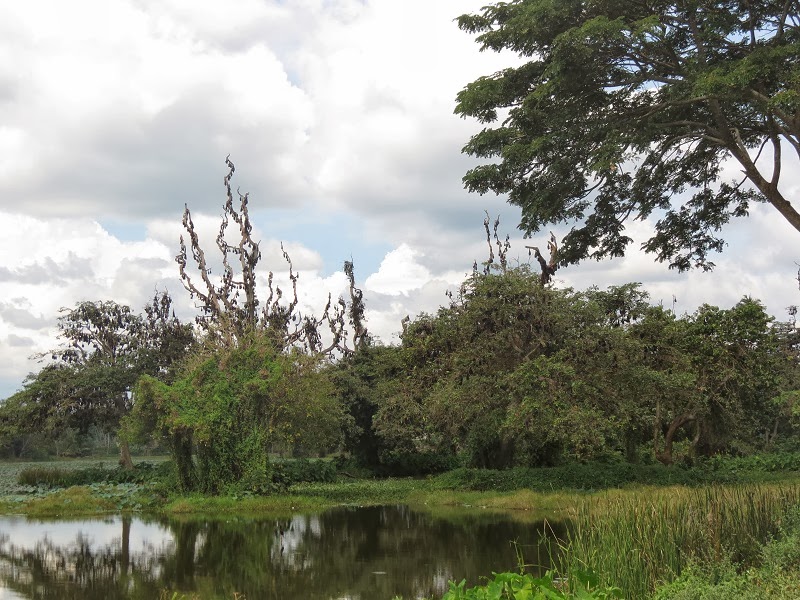
When we came to the edge of this great lake we discovered that the trees spanning one end were home to more than birds. In fact every tree was home to a host of bats - in fact a colony of literally hundreds upon hundreds of bats clustered together.


Some people would panic at such a sight, the threat of B-grade movie induced nightmares lingering upon the edge of their consciousness. It is truly a sad case of affairs that so many people fear and loath bats, for they are remarkable creatures who do so much good for the environment. Farmers love them, for they devour scores of insects each every night, vastly reducing the amount of pesticides needed. They are also responsible for the distribution of seeds for various fruit trees, resulting in their widespread dispersion. They are also harmless to us.
More people die every year from food poisoning at church picnics than have ever died due to bats in the entire history of the planet. (Thank you, Bill Bryson - At Home)


We continued on our five hour drive, passing rice paddies, more lakes and were rewarded with our first view of elephants.


The road gradually began to wind as zigzagged up the mountains. If this drive (and my time generally in Sri Lanka) taught me anything, it's that Sri Lankan people have very few accidents. Don't get me wrong - they drive just as badly as the rest of the world; often a lot worse. The difference is that they don't drive anywhere as fast as the rest of the world. Coming from South Africa, I know bad driving, but in SA we don't just drive badly - we also drive fast and in non-roadworthy vehicles.

We arrived in Ella in the mid afternoon. We didn't stop. Instead we took a side road and kept driving for another seven kilometres along a winding road to our destination - Point View Villa.


What I can say is that previous guests had a sense of humour.


We were shown to our room. The decor could be best described as kitsch. We had orange teddy bears  "artfully" placed on the beds. They smelt musty and felt half sticky, half clammy when we relocated them to a more suitable position (on the floor). The furniture was mismatched. The posters on the walls held no cohesion to one another. We had a kettle that didn't work, along with a few teabags. There were no spoons, nor cups - something one would consider essential for making tea.


The shower room  was alright, although the rubber map on the floor make funny squeaking noises. The absence of hot water was alarming - something we only discovered later that night when we attempted to clean ourselves. It turns out they had forgotten to turn the geyser on. Even when that had been done, the hot water didn't last more than a few minutes, no matter how much time we gave it to heat up.


On arriving we ordered a snack and took some time to evaluate the place we now found ourselves in.


The view, I have to admit, was delightful, and I found myself playing with the filters on my camera. Sepia came out quite nicely. These are some of the pictures I took between mid afternoon and evening.


What concerned us most about Point View Villa was how the standards were lower than Black Beauty Guest House , despite having the same owner and being considerably more expensive to stay at. Anytime one wanted to pop into the village a tuk-tuk had to be called (unless one had time for a three hour walk). That could cost between 450 and 600 rupees, depending on how viciously the driver would haggle.


We popped into the village (which is little more than a single road) the next morning and within minutes had copied down a list of places to stay. We stopped when we had reached about seventeen, but there were more. Clearly we had chosen the wrong place to stay.

Deciding that we would like to leave via the famous - though slow - train, instead of driving, we booked tickets on the train for the following morning. The train left very early, so we knew we'd have to organise with our hosts to get a tuk-tuk ready.

This is the humble train station.


After a little look around the town and a letter or two posted, we headed out of the village in search of one of the famous tea factories. In this regard I have to give our hosts some credit. One of them drew a map for us, telling us which tea factory to go to and giving us directions.

Scenes we passed as we walked along the road.


Sadly my camera wasn't up to the challenge of truly capturing this place. There are layers upon layers of subtle colour changes were rows, angles and different aged tea crops met. Each requires a different light filter and so makes accurate photography highly difficult.


We also found a very relaxed dog, calmly lording over his kingdom. He barely raised his head to consider us as we passed.


Cows grazed along the slopes.


Halfway between our village and the next was a single indicator of our geographical position.


The next village, Kumbalwela, held this. We didn't stop there, but the name was tantalising.


 The Halpewatte Tea Factory had many delights in store for us. As you can imagine, they did not permit photographs to be taken inside the factory, but we were allowed to take scenic shots from their rooftop, which was also their information centre and shop.


Making tea is a long process. We had an elder gentleman take us through the factory. His English was impeccable. In the first process the tea leaves are allowed to sit in a warmed environment to reduce their moisture content. Then they go through a process where they are churned and separated four times - creating the four different variations of tea. The chaff that's left over usually gets used to make compost.

The next process involves baking the tea leaves at a high temperature and then sorting it again into levels of fineness. These different levels have many names and were originally sorted by hand. Now they use machines to filter the different particles. The particles are then packed into large, specially made bags and shipped to Colombo where they go on auction.

Of course the process is much more complicated than this brief overview, naturally.


After leaving the factory and finding no tuk-tuks waiting for us, we began to walk the 1.7 kilometres back to the road. We took some pictures along the way and staged a few.


We caught a tuk-tuk along the way and, a little tired from the day's exertions, we took it all the way back to Ella. There we found a place to have lunch. It was called Nilmini Restaurant and it was right next to the road that led to the post office and on to the back of the train station.
The lady who ran it was a granny and the place was in fact her house. She was so generous and caring. We ordered smoothies which she made fresh, and then she came out with the extra and kept topping up our drinks. She made curry from scratch and provided a dazzling array of side dishes to accompany it. We were so impressed that we ordered a take-away breakfast to be collected the next morning from her on our way to the train.


If you're ever in Ella - find this restaurant. The lady here deserves your patronage.


Ella is also home to many animals and I'm not sure how many are stray, nor who feeds them if they are. Of course I had to take pictures of them.


[I don't know why this picture rotated back.]